
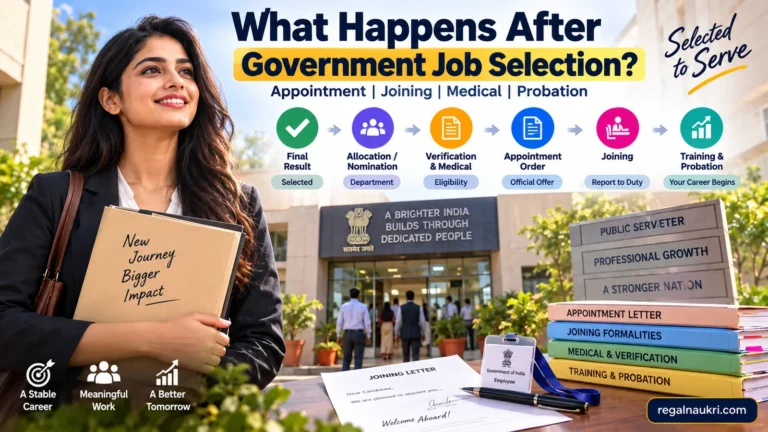



Seeing your name or roll number in a final government recruitment result feels like the finish line. Administratively, it may be the beginning of a new sequence.
A recruiting commission can select or recommend you, but the ministry, department, office, cadre-controlling authority or other user organization may still have to receive your dossier, verify remaining conditions, conduct a post-specific medical or physical test, issue an offer or appointment order, assign a place of posting, and complete joining formalities. After you actually join, training or probation rules may begin.
The most useful way to understand this stage is to separate four words that are often treated as synonyms online: selected, appointed, joined and confirmed. They can describe four different points in the same recruitment journey.
After final government job selection, first read the result notice and identify who controls the next step. In many recruitments, the recruiting commission’s role reduces after it declares the final result or nominates candidates, and the concerned user department or appointing authority handles document scrutiny, post-specific medical or physical standards, appointment correspondence and joining. Do not assume that a final merit-list entry is itself an appointment letter. Wait for the official communication, check all conditions and deadlines, complete any pending verification, report as instructed and keep proof of every submission. After joining, the applicable service rules may require training, departmental examinations, probation or confirmation conditions.
- Selected is not the same as appointed. A final result or recommendation can still be subject to eligibility, suitability, medical, physical, antecedent or departmental conditions.
- Identify the next authority. After a commission declares the result, your file may move to a ministry, department, office, cadre or other user organization.
- Read an appointment/offer communication line by line: post, office, pay, reporting place, joining deadline, documents and conditions all matter.
- Some post-specific physical or medical checks can occur after final selection. SSC CGL 2026 expressly provides this for certain posts.
- Character or antecedent verification can occur before or after joining depending on the recruitment. Do not assume one universal sequence.
- Do not resign from an existing job merely because a result says “selected” without understanding the official appointment and relieving requirements that apply to you.
- Probation length is not universal. For example, SSC’s Combined Hindi Translators Examination 2026 states a two-year probation for candidates appointed through that examination.
- If official correspondence does not arrive, follow the recruitment-specific escalation rule rather than relying only on social-media timelines.
1. Selected, recommended, appointed and joined are different milestones
Recruitment notices and result documents use several terms that candidates often collapse into one. Keeping them separate prevents premature decisions.
| Milestone | What it usually means | What may still remain |
|---|---|---|
| Final selection / recommendation | You have reached the recruitment’s final merit/recommendation stage subject to stated conditions | Department handover, remaining scrutiny, medical/physical checks, appointment formalities |
| Allocation / nomination | Your candidature is assigned or forwarded to a ministry, department, cadre, zone, office or post | Department-side verification and appointment action |
| Offer / appointment order | The competent authority communicates the proposed appointment or engagement and its conditions | Acceptance, documents, medical/antecedent formalities, reporting deadline |
| Joining | You report to the designated authority and complete joining formalities | Training, probation, pending verification or service-specific requirements |
| Confirmation / regularization | You complete the conditions required by the applicable service or engagement rules | Ongoing service obligations continue |
These terms are not perfectly standardized across every recruiting body. Some authorities use “provisional allotment,” “recommendation,” “nomination,” “offer of appointment,” “provisional engagement” or another expression. Always read what the particular notice says the status actually does.
2. Find out who owns your next step after the final result
A common source of anxiety is continuing to contact the examination commission after the candidate’s file has moved elsewhere.
- Open the final result/write-up and note the post, department, zone, cadre or organization shown against your selection, if any.
- Read the original notification for the paragraph explaining post-result document verification, nomination, allocation or appointment formalities.
- Check whether the commission says the concerned User Department/Organization will contact selected candidates.
- Record the official website, recruitment/career page and contact route of that department.
- Keep your registered email address and phone number active and check spam/junk folders.
- Save every official message, letter, portal acknowledgement and submitted document in one recruitment folder.
- Do not treat a coaching-channel message or unofficial “joining date” list as department correspondence.
The SSC Combined Graduate Level Examination, 2026 notice says physical and medical standards for specified posts are examined by the concerned User Department after final selection. It also says candidates finally selected but receiving no correspondence from SSC or the concerned User Department within one year of the final result should communicate thereafter with the User Department. That one-year instruction is an SSC CGL 2026 rule; it is not a universal waiting period for every government recruitment.
3. Allocation or nomination can decide where your file goes
Final selection does not always identify your first desk, city or office immediately. Depending on the recruitment, there can be a separate allocation based on merit, preferences, category, vacancy, cadre, state, zone, service or post-specific rules.
| Possible allocation | What to check |
|---|---|
| Ministry / department | Which organization now controls verification and appointment correspondence |
| Post | Whether the allotted post has special physical, medical, licence, language or training requirements |
| State / UT / zone | Whether service liability, local-language or location conditions apply |
| Cadre / service | Which authority issues the appointment or training instructions |
| Office / station | Whether this is the joining location or only the controlling office |
Do not assume that a preferred department or city can still be changed after final allocation. Some examinations treat post preferences as final and irreversible. If the result or allocation appears inconsistent with your submitted options, use the official representation route and time limit rather than informal requests.
4. Final selection may still be followed by medical or physical checks
The timing of medical examination is recruitment-specific. Some recruitments conduct medical fitness before the final result, while others place post-specific physical or medical standards after selection or nomination.
For certain posts under SSC CGL 2026, SSC states that mandatory physical and medical standards, including physical-efficiency requirements for specified posts, are examined by the concerned User Department after final selection. The notice warns that failure in those tests can affect the candidate’s candidature for the allotted post and that the candidate may not then be considered for another post/department under that rule.
A general statement such as “medical always comes after the merit list” is unsafe. Check the exact selection scheme for your post. Police, defence, railway, technical, field and other services can have very different medical or physical stages.
5. Character, antecedent and certificate verification may continue after selection
A final result does not necessarily mean every external verification report has already been received. Depending on the employer and post, the appointing authority may verify certificates with the issuing institution and may require character, antecedent, police, vigilance or other checks under the applicable rules.
The India Post GDS Online Engagement Schedule-II, July 2026 notification provides a useful current example of a staged post-selection process. After successful document verification, a system-generated offer of provisional engagement can be issued. The candidate must complete pre-engagement formalities within 30 days. The notification then allows a provisional engagement order and joining while verification of educational/category/disability documents and police antecedents remains pending; a final engagement order follows after the reports are received.
GDS engagement has its own statutory/service framework and is not the same as regular Central Government employment, so this example should be used to understand sequencing, not to import GDS rules into another recruitment.
6. Read the appointment or offer communication before making life decisions
Do not scan an appointment letter only for the joining date. Read it as a set of conditions.
Check whether the communication specifies:
- exact post/designation and organization;
- temporary, permanent, provisional, training or other appointment status;
- pay level, scale, stipend or remuneration description;
- place of reporting and controlling authority;
- last date/time for reporting or accepting the offer;
- medical-fitness or physical-standard requirement;
- character/antecedent or police verification condition;
- original certificates, photocopies, photographs and identity proof to bring;
- NOC, relieving order or service record if you are already employed;
- declarations, bonds, undertakings or forms to submit;
- residence, accommodation, language, training or service-liability conditions;
- whether failure to report by the deadline can cause cancellation.
If a letter is unclear, verify it through the issuing department’s official website or contact route before sending sensitive documents or money. A genuine government appointment process should not depend on an unofficial payment link or a messaging-app-only instruction.
7. Do not resign from your current job only because the result says selected
A selected candidate who is already employed may have to manage notice period, NOC, relieving, technical resignation, lien or another service/employment issue. The correct route depends on the current employer, the new post and applicable rules.
Before resigning, identify what official document you actually possess. A final result, allocation list and offer of appointment are not the same thing. Read the new authority’s joining deadline and your current employer’s relieving requirements. If an extension or formal relief is needed, request it through the official channel as early as possible and keep the response.
If your records or application details still contain a discrepancy, review Government Job Application Mistakes and Corrections before assuming the issue will disappear after selection.
8. Prepare a joining file, not just a DV file
The papers needed at joining can overlap with document verification but are not automatically identical. Use the appointment letter or joining instructions as the controlling checklist.
If you are still at the document-verification stage, use the Government Job Document Verification guide first. It explains how to check your application claims against supporting documents, prepare originals and copies, deal with certificate or identity mismatches, and understand what happens on DV day.
Prepare, where instructed:
- appointment/offer letter or downloaded communication;
- joining/reporting form supplied by the department;
- identity proof accepted by the authority;
- matriculation/educational records and other originals named in the letter;
- category/PwBD/ESM or other certificates where requested again;
- medical-fitness certificate or medical-board record if already completed;
- NOC/relieving order/service certificate for existing employees where applicable;
- passport-size photographs in the number/format requested;
- bank/PAN or payroll details only when the employer officially requests them;
- character/attestation forms and declarations, if prescribed;
- copies/self-attested copies in the number stated;
- proof of any extension or special permission granted by the department.
Use Regal Naukri’s Government Job Document Checklist to build a private working list from your appointment instructions. Remove example items that your authority does not request; the tool does not replace the official letter.
For the broader document lifecycle, see Documents Required for Government Jobs in India.
9. Joining deadlines matter, but there is no universal number of days
Appointment and engagement communications can give different acceptance or reporting windows. Some authorities provide a procedure for extension; others can cancel the offer if the candidate does not act within the prescribed period.
In the current India Post GDS Schedule-II, July 2026 notification, successful verification can lead to an offer of provisional engagement, and the candidate is required to complete specified pre-engagement formalities for joining within 30 days. Failure to complete the formalities or join within that stipulated period can lead to cancellation. This 30-day period belongs to that GDS engagement process and must not be treated as a universal joining deadline.
If you cannot join by the stated date:
- Read whether the offer permits an extension or representation.
- Contact the issuing/appointing authority before the deadline, not after it if avoidable.
- State the genuine reason concisely and attach only the evidence the authority requests.
- Ask for a written decision or portal acknowledgement.
- Do not assume silence means the extension is approved.
- Preserve the original deadline and every communication in your records.
10. Posting, zone, service liability and local-language conditions can appear after selection
Selection can be for a national recruitment while the actual service obligation is tied to a state, zone, office or all-India liability.
The SSC Combined Hindi Translators Examination, 2026 notice says candidates selected for appointment carry All India Service Liability. It also says a finally selected candidate may be allotted a State/UT/Zone by the concerned User Organization/Office and may be required to acquire proficiency in the local language for confirmation to the allotted post.
Before treating a posting as an error, compare it with the service-liability and preference rules you accepted when applying. Read How to Read a Government Job Notification if you need to recheck the original service and posting clauses.
11. Probation, training and confirmation begin after appointment—not at the merit list
Probation is part of service, not merely another recruitment result. Its duration, training, tests and confirmation conditions are determined by the relevant recruitment/service rules.
| Term | Practical meaning |
|---|---|
| Training | Instruction or course required for the job; may occur before or during probation |
| Probation | Initial service period in which performance, conduct, training/tests or suitability can be assessed under applicable rules |
| Departmental examination | A test some services require during training/probation or for confirmation/progression |
| Confirmation | Formal service status reached after satisfying the applicable conditions; it is not automatic merely because the stated probation time has elapsed |
The SSC Combined Hindi Translators Examination, 2026 notice states that candidates appointed through that examination are on two years’ probation and can be required to undergo prescribed training or pass examinations. It says confirmation follows successful completion of probation if the candidate is considered fit for permanent appointment by the Controlling Authority. This two-year period is a recruitment-specific example, not a universal probation duration for all government jobs.
12. What to do if no appointment or joining communication arrives
Waiting periods vary widely because result declaration, dossier transfer, allocation, verification and departmental processing do not move at the same speed in every recruitment.
Before escalating:
- confirm that the result actually says final selection/recommendation, not only shortlisting;
- check whether a separate allocation/nomination list was issued;
- verify the email address and mobile number registered with the recruitment;
- check spam/junk and the department’s official recruitment page;
- search for a notice about dossier transfer, appointment formalities or document verification;
- identify the authority that currently owns the file;
- follow the recruitment’s stated waiting/escalation period if one exists;
- keep your query factual: examination, roll/registration number, post/allocation and result date.
SSC’s CGL 2026 and Combined Hindi Translators 2026 notices both contain a one-year follow-up instruction for finally selected candidates who receive no correspondence from the concerned user organization/department. That does not mean a candidate should ignore a shorter deadline in an appointment notice or that every non-SSC recruitment uses one year.
13. Selection-to-first-working-day checklist
Use this as a control sheet, then replace each item with the exact requirement from your recruitment.
- Save the final result and allocation/nomination notice.
- Identify the ministry/department/office now responsible for your candidature.
- Confirm whether DV, medical, physical, antecedent or certificate verification is still pending.
- Keep registered email/phone active and monitor the official department website.
- Read every appointment/offer condition, not only the reporting date.
- Verify post, pay/level, place of reporting and service-liability terms.
- Prepare the joining file exactly in the requested order.
- If already employed, obtain the required NOC/relieving action before the joining deadline.
- Ask for an extension only through the official route and retain written proof.
- Report on time and obtain an acknowledgement/joining record where provided.
- Read training, probation, departmental-exam and confirmation rules after joining.
- Keep copies of appointment, joining, medical, verification and service documents securely for future use.
A final government job selection is an important milestone, but the safest next move is to ask “Who owns my file now, and what condition must I satisfy next?” Follow the official handover from commission to department, complete pending verification, read the appointment order carefully, meet the joining deadline and then treat training/probation as part of your new service—not as an afterthought.
Frequently Asked Questions
Does final selection mean I have definitely got the government job?
Not always. A final selection or recommendation can still be subject to the conditions in the recruitment notice and appointment process, including department-side verification, medical/physical standards, antecedent checks or other eligibility requirements.
What is the difference between a final result and an appointment letter?
The final result records the recruitment outcome. An appointment or offer letter is issued by the competent authority and normally states the post, conditions, reporting instructions and deadline for taking up the appointment.
Can medical examination happen after final selection?
Yes in some recruitments. For example, SSC CGL 2026 specifies post-selection physical and medical examination by the concerned User Department for certain posts. Other recruitments use a different sequence.
Who should I contact after selection—SSC or the allotted department?
Follow the result and notification. Once the commission has handed your candidature to a User Department/Organization, that department may control DV, appointment and joining. Use the specific contact/escalation rule for your examination.
Should I resign from my current job as soon as my name appears in the final merit list?
Do not make that decision from the merit list alone. First read the official appointment/offer communication and understand your current employer’s NOC, notice-period and relieving requirements.
What documents are required at government job joining?
The appointment or joining instructions control the list. Common items can include the offer letter, identity proof, education/category records, photographs, medical records, NOC/relieving documents and prescribed forms, but there is no universal joining checklist.
How long do I get to join after receiving an appointment letter?
There is no universal period. Use the deadline in your own offer/appointment communication. India Post’s July 2026 GDS notification, for example, uses a 30-day pre-engagement/joining period in its own process, but that rule should not be copied to other recruitments.
Is probation always two years in a government job?
No. Probation is service-specific. SSC’s Combined Hindi Translators Examination 2026 provides a two-year probation for appointments through that examination, but another post can have different rules.
What if I am selected but receive no communication?
First confirm the selection is final and identify the user department. Check official portals, registered email/phone and any allocation notice. Then follow the examination’s stated escalation rule. Some SSC 2026 notices tell finally selected candidates to contact the concerned user department after one year if no correspondence has arrived.